

Bukit Batu Shapes Cultural Memory and Leadership Values
By Syahrul Mubarok, S.Sos
Young Sociologist
OPINION, folitimes.id – Amid the rapid pace of modernization, people often view sacred places merely as tourist destinations or remnants of the past.
Such a perspective reduces their deeper meaning.
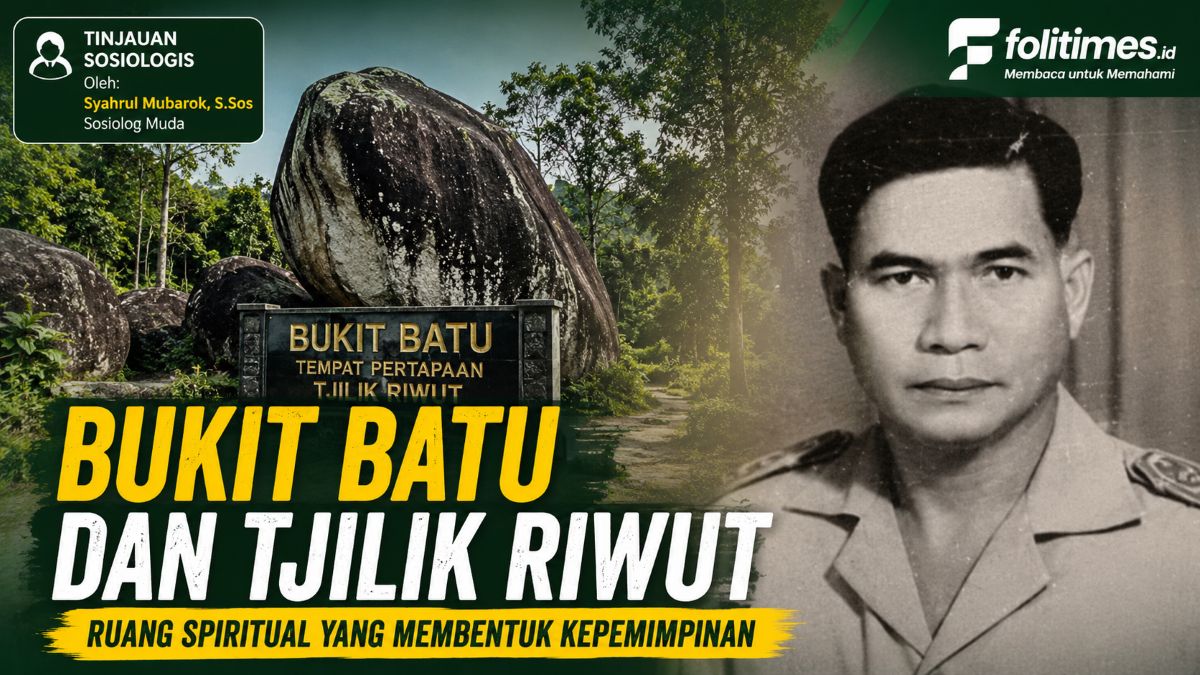
Bukit Batu in Katingan Regency, Central Kalimantan, offers an example of how a physical location can become a social, cultural, and spiritual space that shapes the character of a leader.
Bukit Batu is not merely a group of granite rocks standing firmly within the forest.
The site holds an important place in the life journey of Tjilik Riwut.
Historical sources and accounts concerning Tjilik Riwut describe Bukit Batu as a place he frequently visited to meditate, reflect, and draw closer to the Creator according to Dayak traditions.
The area is now also recognized as a historical site and cultural tourism destination in Katingan Regency.
However, from a sociological perspective, the meaning of Bukit Batu extends far beyond a spiritual narrative.
Bukit Batu as a Space for Social Awareness
In sociology, space is not understood solely as a geographical location.
Space also shapes values, identities, and patterns of thought within society.
Bukit Batu symbolizes how people establish relationships with nature, their ancestors, and their communities.
For Dayak communities, nature is not an object to be conquered.
Nature forms part of life and must be respected.
For centuries, this philosophy has shaped the character of Indigenous communities across Kalimantan.
When Tjilik Riwut chose Bukit Batu as a place for reflection, his actions cannot be interpreted merely as a private spiritual practice.
He was also establishing a social relationship with his own cultural identity.
Modern sociology may describe this process as the formation of collective identity.
Leadership Does Not Always Emerge from Political Power
Many leaders emerge from political institutions.
Others emerge from academic environments.
History also shows that some leaders emerge from spaces of contemplation.
Bukit Batu represents the idea that leadership does not develop only through formal education.
Leadership can also grow through a long process of reflection.
Tjilik Riwut is known as a figure who played an important role in defending Kalimantan as part of the Republic of Indonesia and in the development of Central Kalimantan.
He also maintained a close relationship with Indigenous communities because he understood the cultural values of the environment in which he grew up.
From a sociological perspective, such spiritual experiences may shape what scholars call value-based leadership.
A leader does not make decisions solely through authority.
A leader may also act according to deeply held cultural values.
Spirituality and Rationality Are Not Opposing Forces
Modernization often places spirituality in opposition to rationality.
In reality, the two can exist side by side.
Within Dayak society, rituals are not merely religious or customary practices.
They also serve as a means of developing self-discipline, controlling emotions, strengthening responsibility, and affirming the relationship between human beings and nature.
From the perspective of the sociology of religion, such practices help strengthen social solidarity and preserve shared values.
Therefore, when Bukit Batu is understood as a place where Tjilik Riwut meditated, its most important meaning does not lie in the mystical elements often repeated in public stories.
Its deeper meaning lies in the process of shaping a leader’s character through reflection and closeness to his own culture.
Bukit Batu as the Collective Memory of Dayak Society
Every region has symbols that shape the identity of its people.
Yogyakarta has the Tugu Monument.
West Java has Gedung Sate.
Bali has Besakih Temple.
Central Kalimantan has Bukit Batu.
These symbols function as collective memory.
They connect the present generation with the historical journey that shaped regional identity.
Bukit Batu does not belong only to Tjilik Riwut.
It forms part of the social memory of Dayak society.
When younger generations know Bukit Batu only as a tourist destination, part of their cultural identity may gradually disappear.
Preservation Requires More Than Infrastructure
Developing tourism facilities remains important.
Communities need proper roads.
They need complete public facilities.
They need adequate parking areas.
However, cultural preservation cannot end with physical development.
Preserving historical narratives is even more important.
Bukit Batu should serve as an educational, historical, and cultural reflection space.
Young people need to understand why the site matters, rather than simply knowing where it appears on a map.
Conclusion
As a young sociologist, I do not view Bukit Batu merely as a historical site or as the place where Tjilik Riwut once meditated.
Bukit Batu is a social laboratory that shows how culture, spirituality, nature, and leadership shape one another.
Amid increasingly rapid social change, society may need more spaces for reflection than spaces for endless debate.
Perhaps the greatest lesson from Bukit Batu does not concern only the history of Tjilik Riwut.
It also concerns the importance of balancing intellectual intelligence, cultural wisdom, and spiritual depth while building the future of Central Kalimantan.