

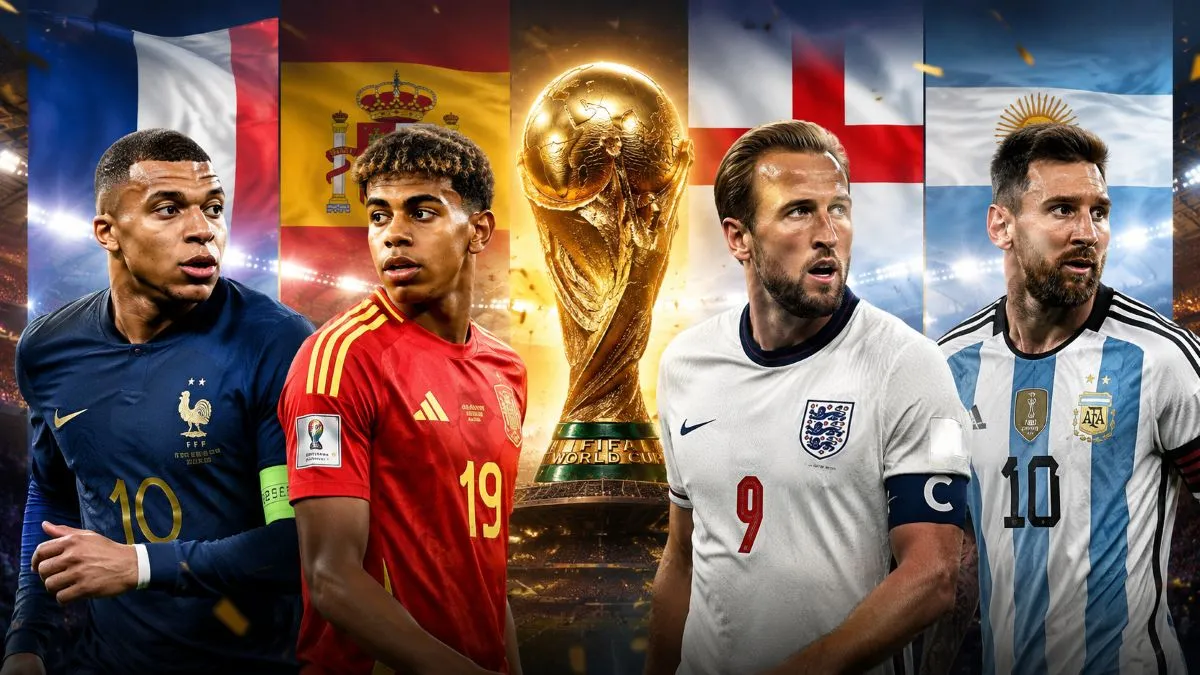
World Cup Semifinals Bring Four Different Roads to Football’s Biggest Prize
JAKARTA, folitimes.id – The 2026 FIFA World Cup has reached a stage where every mistake could decide a nation’s destiny. France, Spain, England, and Argentina now stand only two victories away from lifting football’s most prestigious trophy.
- France Arrive With Defensive Stability
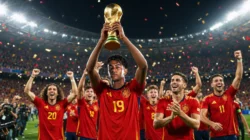
- Spain Trust Possession and Technical Excellence
- France Versus Spain Could Be Decided in Transition
- England Continue to Show Attacking Power
- Argentina Depend on Championship Experience
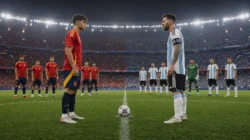
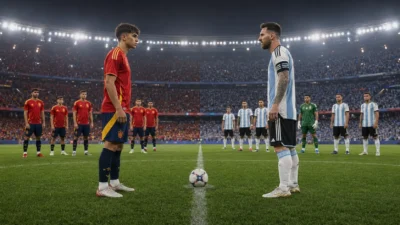
- England and Argentina Renew Historic Rivalry
- Four Contenders, Four Different Strengths
The first semifinal will feature France against Spain in Dallas on Tuesday, July 14, 2026 (local time), corresponding to Wednesday, July 15, at 02:00 WIB.
The second semifinal will see England face Argentina in Atlanta on Wednesday, July 15 (local time), or Thursday, July 16, at 02:00 WIB.
Each semifinalist has followed a different path to the final four. France relies on consistency and defensive discipline. Spain emphasizes possession and technical control. England combines physical strength with attacking depth, while Argentina depends on championship experience and Lionel Messi’s creativity.
France Arrive With Defensive Stability
France enter the semifinals boasting the strongest defensive record in the knockout stage. Les Bleus defeated Sweden 3–0, Paraguay 1–0, and Morocco 2–0 without conceding a single goal.
Scoring six goals while keeping three consecutive clean sheets highlights France’s balance between attacking efficiency and defensive organization.
Captain Kylian Mbappé remains the team’s primary attacking threat, but Didier Deschamps also benefits from the creativity of Ousmane Dembélé, Michael Olise, Désiré Doué, and several other attacking options.
France do not always dominate possession. Instead, they focus on maintaining compact defensive lines and launching rapid counterattacks, an approach that could become decisive against Spain’s possession-oriented style.
Spain Trust Possession and Technical Excellence
Spain reached the semifinals after defeating Austria 3–0, Portugal 1–0, and Belgium 2–1.
La Roja have scored six goals while conceding only once during the knockout rounds, demonstrating both defensive balance and attacking efficiency.
Rodri controls midfield tempo, while Pedri, Fabián Ruiz, Dani Olmo, and Mikel Merino provide creativity and intelligent movement.
On the wings, Lamine Yamal and Nico Williams offer pace and direct attacking options capable of stretching opposing defenses.
Spain continue to evolve beyond their traditional tiki-taka identity by combining patient build-up play with quicker vertical attacks.
France Versus Spain Could Be Decided in Transition
The opening semifinal presents a clash of contrasting football philosophies.
Spain are expected to dominate possession, whereas France will seek opportunities through quick transitions and counterattacks.
France may hold a slight advantage if the match becomes open, while Spain could control proceedings if they succeed in maintaining territorial dominance.
Based on overall tournament consistency, Folitimes.id projects France with a 52 percent chance of reaching the final, compared with 48 percent for Spain.
These percentages represent editorial analysis rather than official predictions.
England Continue to Show Attacking Power
England advanced after victories over DR Congo, Mexico, and Norway.
Thomas Tuchel’s side has demonstrated impressive attacking quality but has also conceded goals in every knockout match, highlighting occasional defensive vulnerability.
Harry Kane remains England’s central figure, supported by Jude Bellingham, Declan Rice, Bukayo Saka, Cole Palmer, Phil Foden, and Anthony Gordon.
England possess enough attacking depth to change matches quickly, but maintaining defensive stability remains essential against Argentina.
Argentina Depend on Championship Experience
Argentina have produced the highest scoring record among the remaining semifinalists.
Victories over Cape Verde, Egypt, and Switzerland yielded nine goals while exposing occasional defensive weaknesses.
Lionel Messi continues to dictate Argentina’s attacking rhythm through vision, passing, and decision-making rather than constant physical movement.
Julián Álvarez, Lautaro Martínez, Rodrigo De Paul, Alexis Mac Allister, and Enzo Fernández provide additional creativity, pressing intensity, and finishing quality.
Argentina’s experience in major tournament finals offers an important psychological advantage heading into another high-pressure encounter.
England and Argentina Renew Historic Rivalry
Meetings between England and Argentina have long extended beyond tactical football.
Their World Cup history includes memorable encounters in 1966, Diego Maradona’s legendary performance in 1986, and another dramatic meeting decided by penalties in 1998.
This semifinal introduces a new chapter in one of international football’s most famous rivalries.
England possess superior physicality and squad depth, while Argentina bring tactical flexibility, championship experience, and Lionel Messi’s leadership.
Folitimes.id projects Argentina with a 54 percent chance of advancing to the final, while England hold 46 percent.
Four Contenders, Four Different Strengths
France remain the tournament’s most consistent side.
Spain continue to impress through technical superiority and structured possession.
England combine resilience with attacking depth.
Argentina offer creativity, championship mentality, and experience in decisive matches.
Each team possesses enough quality to become world champion.
As the tournament enters its defining stage, composure under pressure may prove even more valuable than individual brilliance.
The World Cup semifinal often rewards the team that remains calm when expectations reach their highest point.