


- Major Banks Took Control of the Market
- Performance of Major Bank Stocks
- BRIS Surged Nearly 10 Percent
- Small Bank Stocks Entered Speculative Territory
- TLKM Supported Infrastructure and Telecommunications
- Energy Stocks Did Not Move in One Direction
- Selected Energy Stock Performance
- Why Did Energy Stocks Lag?
- Mining and Basic Materials Remained Divided
- Basic Materials and Mining Stock Performance
- KLBF Rose as Health Stocks Moved Selectively
- Second-Tier Stocks Recorded Extreme Volatility
- Fund Rotation Became the Main Explanation
- Heavy Volume Did Not Guarantee a Healthy Market
- Market Potential in the Next Session
- The Rally Was Uneven and Risks Remained
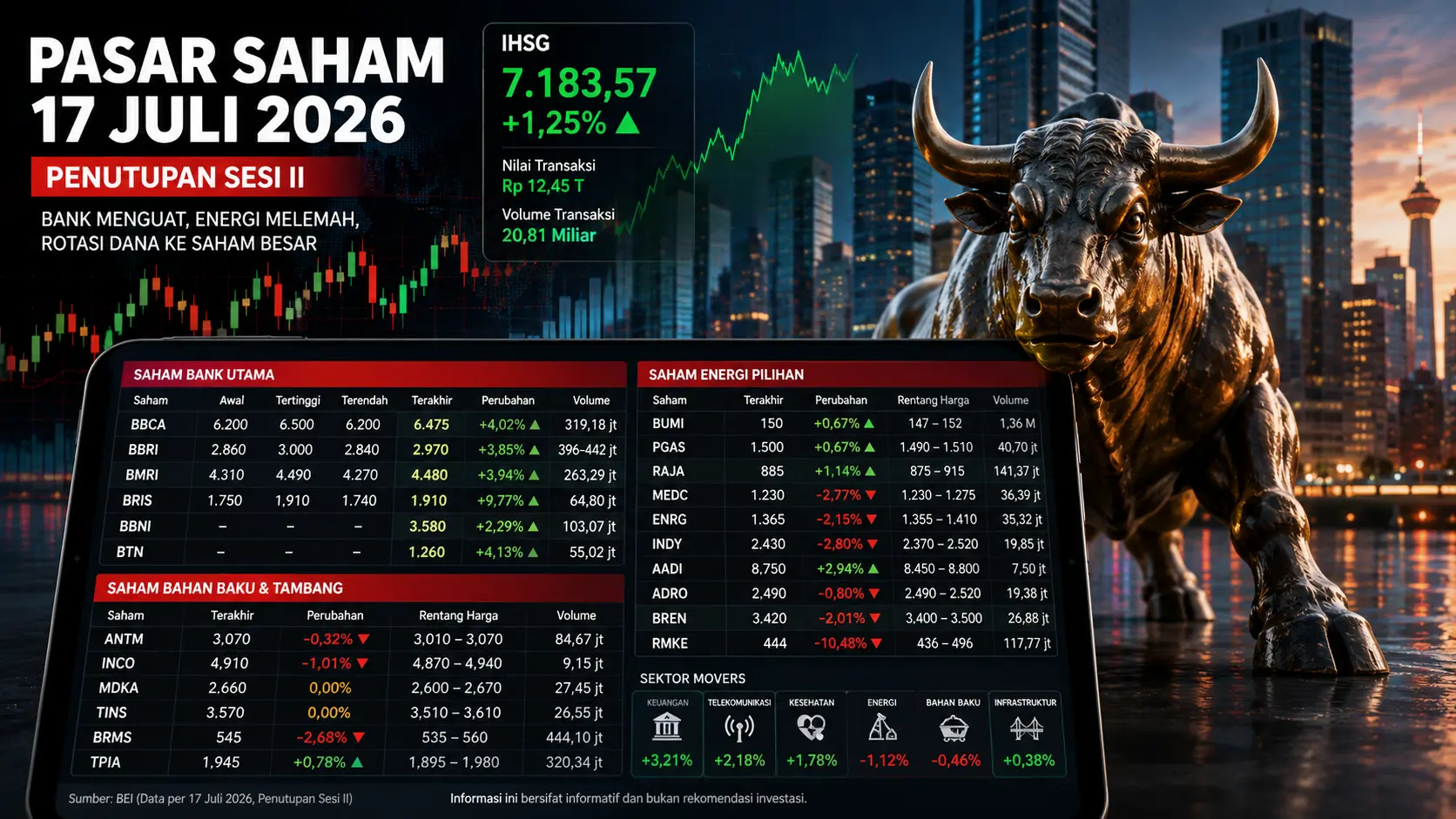
BBCA, BBRI, BMRI, BRIS, and TLKM became the center of attention. All five gained on relatively active volume. In contrast, MEDC, ENRG, INDY, BREN, and RMKE weakened.
The situation showed that the market was undergoing sector rotation. However, that rotation was not enough to conclude that the entire market had entered a new upward trend.
Major Banks Took Control of the Market
The financial sector became the main market driver. Large bank stocks rose together and closed near their intraday highs.
BBCA opened at Rp6,200. The stock reached Rp6,500 before closing at Rp6,475. It gained about 4.02 percent on approximately 319.18 million shares.
BBCA’s volume exceeded its three-month average of around 271 million shares. The combination of rising prices and stronger volume indicated more substantial demand.
However, the market failed to push BBCA to close exactly at Rp6,500. That condition turned Rp6,500 into a psychological barrier that the stock must break in the next session.
BBRI showed a similar pattern. Bank Rakyat Indonesia opened at Rp2,860 and briefly fell to Rp2,840.
Buyers later pushed BBRI to Rp3,000. The stock eventually closed at Rp2,970, up about 3.85 percent.
BBRI’s volume ranged from 396 million to 442 million shares. That figure exceeded its three-month average of around 326 million shares.
Even so, selling pressure emerged when BBRI reached Rp3,000. Investors appeared to use that psychological level to lock in profits.
BMRI opened at Rp4,310. Bank Mandiri briefly dropped to Rp4,270 before strengthening to Rp4,490.
At the close, BMRI stood at Rp4,480, up about 3.94 percent. Trading volume reached approximately 263.29 million shares.
A close only Rp10 below the session high showed that buyers remained active until the end.
Performance of Major Bank Stocks
| Stock | Open | High | Low | Close | Change | Volume |
|---|---|---|---|---|---|---|
| BBCA | Rp6,200 | Rp6,500 | Rp6,200 | Rp6,475 | ▲ 4.02% | 319.18 million |
| BBRI | Rp2,860 | Rp3,000 | Rp2,840 | Rp2,970 | ▲ 3.85% | 396–442 million |
| BMRI | Rp4,310 | Rp4,490 | Rp4,270 | Rp4,480 | ▲ 3.94% | 263.29 million |
| BRIS | Rp1,750 | Rp1,910 | Rp1,740 | Rp1,910 | ▲ 9.77% | 64.80 million |
| BBNI | Not yet verified | Rp3,580 | ▲ 2.29% | 103.07 million | ||
| BTN | Not yet verified | Rp1,260 | ▲ 4.13% | 55.02 million | ||
BRIS Surged Nearly 10 Percent
BRIS recorded the most aggressive move among large and mid-sized banks.
Bank Syariah Indonesia opened at Rp1,750. The price then climbed to Rp1,910 and stayed there until the market closed.
BRIS gained about 9.77 percent on 64.8 million shares. The figure was more than three times its three-month average of only around 19.7 million shares.
The pattern reflected aggressive demand. Buyers not only pushed the price higher but also kept the stock at its intraday peak.
However, a nearly 10 percent increase in one session created a new risk. Short-term investors may take profits in the next trading session.
The Rp1,800 to Rp1,850 area will serve as the first support zone. If BRIS stays above it, momentum may continue.
Conversely, a fall below Rp1,750 may indicate that Friday’s surge was temporary.
Small Bank Stocks Entered Speculative Territory
Sharp gains also appeared in low-priced bank stocks.
BBYB rose about 11.97 percent to Rp262 on 160.76 million shares. BACA closed at Rp121, up around 17.48 percent.
BVIC also advanced about 10.71 percent to Rp93.
Double-digit gains in small banks do not always reflect fundamental improvement. Low prices, liquidity conditions, and concentrated transactions can trigger very rapid jumps.
The downside risk can be equally large. Once buying demand disappears, prices may reverse sharply.
Investors should review disclosures, broker transactions, and special notation status before chasing such gains.
TLKM Supported Infrastructure and Telecommunications
TLKM also strengthened the market. Telkom Indonesia moved from an intraday low of Rp2,540 to a high of Rp2,670.
TLKM closed at Rp2,660, up about 5.14 percent. Volume reached approximately 143.96 million shares.
A close near the session high showed that buyers remained active until the second session ended.
TLKM’s rise also carried significant index weight because of its large market capitalization.
The rotation into TLKM may reflect demand for liquid and defensive stocks. Investors tend to favor companies with relatively stable revenue when market uncertainty remains.
Rp2,670 is the nearest resistance. A breakout on strong volume could open a wider recovery path.
Energy Stocks Did Not Move in One Direction
Unlike financial stocks, energy shares moved unevenly.
BUMI recorded one of the highest trading volumes at around 1.36 billion shares.
However, its price only moved between Rp147 and Rp152. The stock opened and closed at Rp150.
A narrow range on massive volume showed an intense balance between buyers and sellers.
High volume does not automatically mean accumulation. When price cannot escape its range, large transactions may reflect ownership transfers or distribution.
PGAS edged up about 0.67 percent to Rp1,500. RAJA gained around 1.14 percent and closed at Rp885.
AADI also rose about 2.94 percent to Rp8,750.
Several other energy stocks moved in the opposite direction.
MEDC fell about 2.77 percent to Rp1,230. ENRG declined 2.15 percent to Rp1,365.
INDY closed at Rp2,430, down around 2.80 percent. ADRO slipped 0.80 percent to Rp2,490.
BREN also fell about 2.01 percent to Rp3,420.
The sharpest pressure appeared in RMKE. The stock plunged about 10.48 percent to Rp444 on 117.77 million shares.
Selected Energy Stock Performance
| Stock | Close | Change | Price Range | Volume |
|---|---|---|---|---|
| BUMI | Rp150 | ▲ 0.67% | Rp147–Rp152 | 1.36 billion |
| PGAS | Rp1,500 | ▲ 0.67% | Rp1,490–Rp1,510 | 40.70 million |
| RAJA | Rp885 | ▲ 1.14% | Rp875–Rp915 | 141.37 million |
| MEDC | Rp1,230 | ▼ 2.77% | Rp1,230–Rp1,275 | 36.39 million |
| ENRG | Rp1,365 | ▼ 2.15% | Rp1,355–Rp1,410 | 35.32 million |
| INDY | Rp2,430 | ▼ 2.80% | Rp2,370–Rp2,520 | 19.85 million |
| AADI | Rp8,750 | ▲ 2.94% | Rp8,450–Rp8,800 | 7.50 million |
| ADRO | Rp2,490 | ▼ 0.80% | Rp2,490–Rp2,520 | 19.38 million |
| BREN | Rp3,420 | ▼ 2.01% | Rp3,400–Rp3,500 | 26.88 million |
| RMKE | Rp444 | ▼ 10.48% | Rp436–Rp496 | 117.77 million |
Why Did Energy Stocks Lag?
Weakness in several energy shares showed that global commodity sentiment did not lift every issuer equally.
Investors also considered valuation, operating performance, debt, expansion plans, and the risk of falling commodity prices.
Profit-taking can emerge after a stock has risen for several sessions.
Rotation into banking shares may also reduce liquidity in energy stocks. Limited funds force investors to choose sectors with the strongest momentum.
For the next session, energy stocks still lack a uniform direction. Investors need to watch whether gains remain limited to selected issuers or spread across the sector.
Mining and Basic Materials Remained Divided
Basic materials and mining stocks also moved in mixed directions.
ANTM closed at Rp3,070, down around 0.32 percent. Volume reached approximately 84.67 million shares.
INCO fell 1.01 percent to Rp4,910. It traded between Rp4,870 and Rp4,940.
MDKA ended unchanged at Rp2,660. TINS also closed flat at Rp3,570.
BRMS attracted attention with volume of around 444.10 million shares. However, it fell about 2.68 percent to Rp545.
A price decline on heavy volume may indicate selling pressure. The market must watch whether BRMS continues to weaken or buyers begin absorbing supply.
TPIA performed better. It rose around 0.78 percent to Rp1,945 on 320.34 million shares.
Basic Materials and Mining Stock Performance
| Stock | Close | Change | Price Range | Volume |
|---|---|---|---|---|
| ANTM | Rp3,070 | ▼ 0.32% | Rp3,010–Rp3,070 | 84.67 million |
| INCO | Rp4,910 | ▼ 1.01% | Rp4,870–Rp4,940 | 9.15 million |
| MDKA | Rp2,660 | ■ 0.00% | Rp2,600–Rp2,670 | 27.45 million |
| TINS | Rp3,570 | ■ 0.00% | Rp3,510–Rp3,610 | 26.55 million |
| BRMS | Rp545 | ▼ 2.68% | Rp535–Rp560 | 444.10 million |
| TPIA | Rp1,945 | ▲ 0.78% | Rp1,895–Rp1,980 | 320.34 million |
The fragmented movement showed that mining stocks had no single catalyst.
Gold, nickel, tin, and copper prices affected each issuer differently. The rupiah exchange rate and energy costs also influenced margins.
KLBF Rose as Health Stocks Moved Selectively
KLBF gained about 5.56 percent and closed at Rp760.
Kalbe Farma traded between Rp715 and Rp760. Volume reached approximately 114.75 million shares.
A close at the session high showed that demand lasted until the end.
Investors may have entered KLBF because of its defensive business profile. Health care and essential consumer stocks often attract buyers during uncertain market conditions.
However, KLBF’s rise did not mean that the entire health sector strengthened. Several smaller-cap health stocks faced sharp pressure.
The condition again highlighted market selectivity. Investors were not buying the whole sector, but choosing specific issuers based on liquidity and risk profile.
Second-Tier Stocks Recorded Extreme Volatility
The greatest volatility emerged in second-tier and low-priced shares.
KOKA rose about 27.49 percent to Rp218. It closed at its session high on around 322.67 million shares.
First Media also gained approximately 26.85 percent to Rp137 on roughly 635.40 million shares.
MLPT rose about 17.96 percent to Rp29,225. BACA gained 17.48 percent to Rp121.
On the other side, RMKE fell more than 10 percent. NAYZ dropped about 10.95 percent to Rp895.
Double-digit gains or losses should not be read from price changes alone. Investors must examine the reason behind transactions, disclosures, ownership concentration, and order-book depth.
Stocks with limited liquidity can move sharply even when the transaction value is not particularly large.
Fund Rotation Became the Main Explanation
Friday’s trading showed a clear rotation of funds.
Investors appeared to exit several energy and mining stocks and move into major banks, TLKM, and KLBF.
Several factors may explain the pattern.
First, bank stocks had faced pressure in earlier periods. That created room for renewed buying at prices considered more attractive.
Second, large banks offer deep liquidity. Institutional investors can enter and exit more easily without causing excessive price swings.
Third, investors started seeking defensive and large-cap stocks. That strategy often appears when global and domestic risks remain.
Fourth, trading ahead of the weekend encouraged portfolio rebalancing. Some investors locked in profits, while others opened positions for the following week.
Heavy Volume Did Not Guarantee a Healthy Market
Trading volume must be interpreted carefully.
BUMI recorded more than one billion shares in volume, but its price barely moved.
BRMS also posted hundreds of millions of shares in volume, yet its price fell.
That pattern differed from BBCA, BMRI, BRIS, TLKM, and KLBF. Those stocks rose and closed near their session highs.
Price gains supported by volume usually provide a stronger signal. Even so, investors must confirm whether the buying continues in the next session.
Final market-wide volume and transaction value should refer to the official recap from the Indonesia Stock Exchange. The exchange provides trading summaries, stock summaries, and statistical reports as the official market reference.
Market Potential in the Next Session
The financial sector still has room to continue rising. However, Friday’s sharp gains also increased the risk of profit-taking.
BBCA needs to break Rp6,500 to strengthen its momentum. The Rp6,200 to Rp6,225 area is the nearest support.
BBRI faces resistance at Rp3,000. It needs to stay above Rp2,900 to maintain its recovery trend.
BMRI has a psychological barrier around Rp4,500. Initial support lies near Rp4,300.
BRIS carries the strongest momentum but also the highest correction risk. The Rp1,800 to Rp1,850 area remains important.
TLKM may still test Rp2,670. A breakout could extend the recovery.
The energy sector requires further confirmation. As long as MEDC, ENRG, INDY, ADRO, and BREN do not move together, the sector remains selective.
Mining stocks also lack a unified direction. Investors need to monitor global commodity prices and the rupiah.
The Rally Was Uneven and Risks Remained
Trading on July 17, 2026, produced positive signals but did not create a broad market rally.
Major banks, TLKM, and KLBF became the main buying targets. Energy and mining stocks remained divided.
Second-tier stocks also recorded extreme volatility. That may attract short-term traders, but it also increases risk.
The market will test the durability of Friday’s gains in the next session. If major banks maintain both price and volume, the recovery may continue.
However, if profit-taking spreads, Friday’s rise may turn into a brief rebound.
Investors must distinguish stocks supported by genuine accumulation from those driven mainly by speculation.
Note: This analysis is provided for market information and does not constitute a recommendation to buy or sell securities.